Wow! It finally happened today...something that I think I remember Steve Jobs saying would NEVER happen: A VIDEO iPOD (Apple.com) (FastCompany Article)
I have only recently integrated podcasting into my daily routine. I download a couple of my favorites and listen during my 30min drive to work. I LOVE IT!
Every morning I think wouldn't it be cool if employees that have even a 15min commute could grab their iPod and get some relevant work information for the day.
NOW...that endearing little gizmo can be one of the greatest learning tools with all sorts of possibilities.
Just think of all the knowledge nuggets you could put on a server and deliver via RSS feeds...text, audio, AND video. Now that's going to be cool...
no...
make that VERY VERY COOL!
Wednesday, October 12, 2005


Tuesday, October 11, 2005
Web2.0 Learning Game
The dynamic nature of the web has been given a name...Web2.0. Thanks to Mr. O'Reilly we have a really picture of what the web is evolving into.
What Is Web 2.0 by Tim O'Reilly -- Defining just what Web 2.0 means (the term was first coined at a conference brainstorming session between O'Reilly and MediaLive International, which also spawned the Web 2.0 Conference), still engenders much disagreement. Some decry it as a meaningless marketing buzzword, while others have accepted it as the new conventional wisdom. Tim O'Reilly attempts to clarify just what we meant by Web 2.0, digging into what it means to view the Web as a platform and which applications fall squarely under its purview, and which do not.
So here's the game...
Read the article and come up with all the different ways you see Web2.0 having an impact on learning in your organization. How can we leverage how the Digital Natives use the web to improve our learning environments?
Tuesday, October 04, 2005
Learner-Created Learning
Parkin's Lot
Another blog on the corporate world of eLearning. We share similar views.
You should check it out.
I think most people love to share what they know. I'm not surprised by the incredible statistics around the increases in bloggers, the size of Wikipedia, and over-whelming use of social networking applications. I don't care if Web2.0 is overhyped. It's still great to see the shift whatever you call it.
Besides...I'm testing out a trackback link to see why its different from the regular link.
Another blog on the corporate world of eLearning. We share similar views.
You should check it out.
I think most people love to share what they know. I'm not surprised by the incredible statistics around the increases in bloggers, the size of Wikipedia, and over-whelming use of social networking applications. I don't care if Web2.0 is overhyped. It's still great to see the shift whatever you call it.
Besides...I'm testing out a trackback link to see why its different from the regular link.
Monday, October 03, 2005
Storytelling - Graphic Novels - eLearning
Web Comics Review
Web Comics Review has a great article on the history of web comics and in reading it I am reminded how fun graphic novels are to engage in. And also, how much we can learn by following an engaging story line.
Stories put information and data into a familiar context for the recipient. Using short metaphors in our training is helpful, however I've seen very few well designed metaphors or stories within eLearning that are graphically represented utilizing the design style of the graphic novel or comic strip.
Everyone loves a good comic strip. What a fun way to translate information into meaning for our end users.
Web Comics Review has a great article on the history of web comics and in reading it I am reminded how fun graphic novels are to engage in. And also, how much we can learn by following an engaging story line.
Stories put information and data into a familiar context for the recipient. Using short metaphors in our training is helpful, however I've seen very few well designed metaphors or stories within eLearning that are graphically represented utilizing the design style of the graphic novel or comic strip.
Everyone loves a good comic strip. What a fun way to translate information into meaning for our end users.
Tuesday, September 27, 2005
Creating Passionate Learners
I stumbled upon Kathy Sierra's blog again today...(can't remember how or why) Creating Passionate Users. She is an awesomely unique spirit, and it is reflected in her blog. While most of her rants are not around corporate eLearning...they smack of similar issues and concerns that eLearning developers face from day to day. After all we are software developers too, right?
She has a great post titled Most Classroom Learning Sucks. I couldn't agree more. I'll add that most eLearing sucks too. We continue to create page-turning online learning that is nothing more than structured html pages order like chapters in a book. What's worse is that we continue to fool ourselves (myself included at times) into believing that what we really need is more Flash, and more interactive Flash animtions, and on, and on. Its all boring junk... UNLESS...
it's wildly entertaining...
the user has a powerful motivator either internal or external...
OR the user is engaged in a collaborative discussion, helping to create the content while learning it, asking questions, solving problems, responding to feedback, applying the knowledge in a familiar context, experimenting with the new knowledge, etc.
She has a great post titled Most Classroom Learning Sucks. I couldn't agree more. I'll add that most eLearing sucks too. We continue to create page-turning online learning that is nothing more than structured html pages order like chapters in a book. What's worse is that we continue to fool ourselves (myself included at times) into believing that what we really need is more Flash, and more interactive Flash animtions, and on, and on. Its all boring junk... UNLESS...
it's wildly entertaining...
the user has a powerful motivator either internal or external...
OR the user is engaged in a collaborative discussion, helping to create the content while learning it, asking questions, solving problems, responding to feedback, applying the knowledge in a familiar context, experimenting with the new knowledge, etc.
Viral Learning
What makes an idea viral? Seth Godin, the marketing guru, has posed this question on his blog and listed some excellent points to consider as we try and answer this question.
As we continue to move towards a world where we all create content and participate in the exchange of ideas it’s becoming increasingly important to understand this as a new literacy. Marketers and the knowledge they have will increasingly become a part of the morphing world of ISD. Crafting images, text and “the message” is what marketers DO. It is increasingly more important to understand that it is also what WE DO (learning and training professionals). When we are training the masses we are spreading new knowledge throughout the organization. Isn’t that VIRAL? What can we learn from viral marketing and begin to look at viral learning?
The Six Simple Principles of Viral Marketing
Learning Dashboards NOT portals
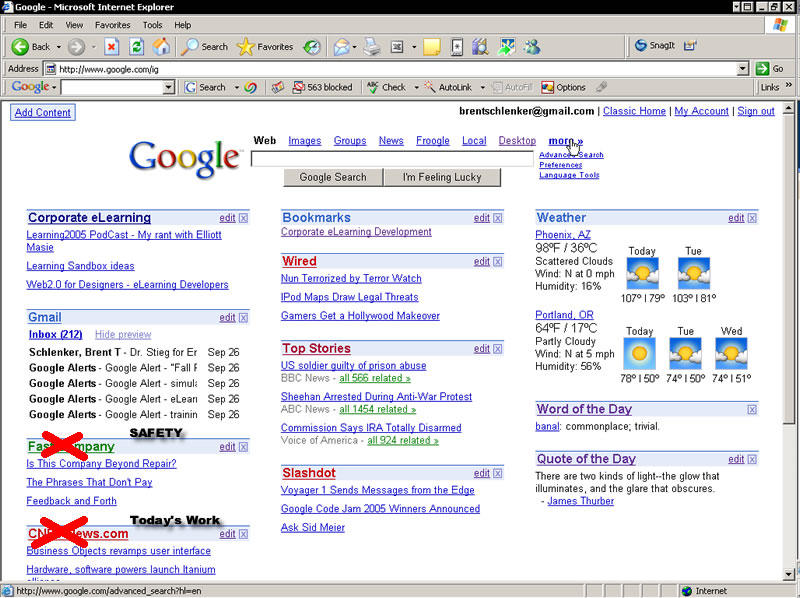 Web portals are old and useless. Especially when one corporate gatekeeper(s) creates the portal with content of their choosing. Okay so maybe they give you a tiny amount of space to be modified but your options are slim, and rarely do they have fresh content.
I LOVE my personalized Google homepage and filling the sections with my favorite RSS feeds. (Check out netvibes too)This is MY content where and when I want it. Wow, that sure does sound like the mantra of eLearning and KM professionals now doesn't it...hmmmm.
Wouldn't if be great if our corporate organizations, project/program teams, senior leaders, AND the lowest level employees were ALL blogging, or adding to a WIKI, and generating RSS feeds that could be added to a personal dashboard. Now THAT's communication...in real time.
If we consider the employee of the not so distant future, this will be manditory. The content is going to consist of not only text, but audio(podcasting), and video(vodcasting), engaging users with collaborative tools. The content feeds will be delivered to cellphones, PDAs, and iPods.
This is NOT something that the learning and KM gurus are out there creating and that we will need to buy. These are the tools of the next generation workforce...they exist NOW...and people are using them in amazing ways.
Thursday, September 22, 2005
Learning2005 PodCast - Discussion with Elliott Masie
Today I was part of the beginning of a new type of conference...Learning2005. I talked with Elliott Masie about some of my passions that I blog here at elearndev.blogspot.com.
http://www.learning2005.com/university/
One part that I am definitely going to discuss more with my colleagues in learning is the concept of design independent delivery frameworks that Elliott briefly touched on. If the course I am taking has text, images, animations, video, and other digital elements then I want to be able to put them anywhere I want on the screen. I don't want some know-it-all "ISD guru" telling me how I should be viewing MY content! I love this idea!!!
Also, I must confess that despite "page-turners" being my biggest hot button...I actually create them as much as the rest of you. Here's my kicker on that though...if we MUST create them, then lets design the heck out of them: make beautiful pictures, ENGAGING interactions, animations, etc. I believe we should be digital media designers above and beyond instructional designers.
http://www.learning2005.com/university/
One part that I am definitely going to discuss more with my colleagues in learning is the concept of design independent delivery frameworks that Elliott briefly touched on. If the course I am taking has text, images, animations, video, and other digital elements then I want to be able to put them anywhere I want on the screen. I don't want some know-it-all "ISD guru" telling me how I should be viewing MY content! I love this idea!!!
Also, I must confess that despite "page-turners" being my biggest hot button...I actually create them as much as the rest of you. Here's my kicker on that though...if we MUST create them, then lets design the heck out of them: make beautiful pictures, ENGAGING interactions, animations, etc. I believe we should be digital media designers above and beyond instructional designers.
Tuesday, September 20, 2005
Learning Sandbox ideas
Elliott Masie has a great podcast on creating a learning sandbox. If you have ever seen any of my eLearning conference presentations, then you know my schtick about having an "IT buddy". Setting up a Learning Sandbox is where your IT buddy may come in handy. There are many commercially available wikis, blogs, podcasting and vodcasting servers that charge little or no money, but I've found that my IT buddy was more than happy to help set this up.
Elliott covers the basics of what, why, and how...but here are some additional ideas and links.
PodCasts are great but in some cases video casting, or VodCasting, has the visual element that will really impact learning. The key: Keep it short and focused, and have a supporting blog or wiki for viewers to comment. Once you get it set up find a motivated end-user/learner and see if you can get them to create vodcasts, on specific aspects of their job.
http://freevlog.org/
http://playlistmag.com/features/2005/07/howtovodcast/index.php
http://www.digitmag.co.uk/features/index.cfm?email&FeatureID=1327
Ask your IT buddy which free wiki engine can be installed on your companies current system. Most of them simply need a folder on the webserver. TiddlyWIKI is so cool...it's only ONE .htm file and so you can put it anywhere: HDD, server, USB-drive, iPod, anywhere you hold your files. I'd call it a mini-wiki. But since it serves up an RSS feed you can use an aggregator to link many tiddlywiki users who will be notified as each user updates their personal mini-wiki.
Of course there is always the incredible power of Google(free): Blogger, desktop, search, video.
What about a MMO Gaming environment sandbox? Check out SECOND LIFE to see what collaboration can be (and will be, IMHO). A Free, open environment with the tools to create your own "inworld" elements. Sure a phone conference is cool, but what if everyone could meet inworld and work together with objects and elements that are unavailable or too dangerous in the real world. The possibilities are endless.
So, get out there and play in your sandbox.
Elliott covers the basics of what, why, and how...but here are some additional ideas and links.
PodCasts are great but in some cases video casting, or VodCasting, has the visual element that will really impact learning. The key: Keep it short and focused, and have a supporting blog or wiki for viewers to comment. Once you get it set up find a motivated end-user/learner and see if you can get them to create vodcasts, on specific aspects of their job.
http://freevlog.org/
http://playlistmag.com/features/2005/07/howtovodcast/index.php
http://www.digitmag.co.uk/features/index.cfm?email&FeatureID=1327
Ask your IT buddy which free wiki engine can be installed on your companies current system. Most of them simply need a folder on the webserver. TiddlyWIKI is so cool...it's only ONE .htm file and so you can put it anywhere: HDD, server, USB-drive, iPod, anywhere you hold your files. I'd call it a mini-wiki. But since it serves up an RSS feed you can use an aggregator to link many tiddlywiki users who will be notified as each user updates their personal mini-wiki.
Of course there is always the incredible power of Google(free): Blogger, desktop, search, video.
What about a MMO Gaming environment sandbox? Check out SECOND LIFE to see what collaboration can be (and will be, IMHO). A Free, open environment with the tools to create your own "inworld" elements. Sure a phone conference is cool, but what if everyone could meet inworld and work together with objects and elements that are unavailable or too dangerous in the real world. The possibilities are endless.
So, get out there and play in your sandbox.
Thursday, September 15, 2005
Web2.0 for Designers - eLearning Developers
http://www.digital-web.com/articles/web_2_for_designers/
The above article strengthens my belief that giant enterprise systems will always automate 10 year old technologies and methods. I mostly refer to the world of LMS. 10 years ago we created our own navigation systems, multiple choice testing systems, tracking, database connectivity, help systems, login processes, etc, for each project (with some, but very little, reuse). The LMS of today takes away all of the mundane replication of those pieces of eLearning and automates it with Publishing applications.
So what about Web2.0? Knowing and understanding RSS feeds, communities of practice, and the obvious desire for people to publish content, how do we utilize these technologies NOW? Instead of waiting another 10 years for the enterprise systems to catch up.
And that reminds me of another point I've made in the past...
Why don't we use the tools that exist in the public domain as the tools for knowledge transfer within the walls of the corporation? Even if it is a micro-version available only internally to employees.
The above article strengthens my belief that giant enterprise systems will always automate 10 year old technologies and methods. I mostly refer to the world of LMS. 10 years ago we created our own navigation systems, multiple choice testing systems, tracking, database connectivity, help systems, login processes, etc, for each project (with some, but very little, reuse). The LMS of today takes away all of the mundane replication of those pieces of eLearning and automates it with Publishing applications.
So what about Web2.0? Knowing and understanding RSS feeds, communities of practice, and the obvious desire for people to publish content, how do we utilize these technologies NOW? Instead of waiting another 10 years for the enterprise systems to catch up.
And that reminds me of another point I've made in the past...
Why don't we use the tools that exist in the public domain as the tools for knowledge transfer within the walls of the corporation? Even if it is a micro-version available only internally to employees.
Subscribe to:
Posts (Atom)