Showing posts with label learning. Show all posts

Wednesday, December 19, 2012

2013 Reality - NOT Predictions!

Performance = Our Goal

Learning = Process

Training = Event

 
This is not a new concept.  This is not new to 2013.  But this SHOULD be the way you approach everything you do from now on if you already don't. 
 
Let me point out some of the obvious parts of this stack...
 
1. TRAINING is at the BOTTOM!
2. Impacting the performance of your companies employees is your ONLY goal. Relentlessly focus on measuring this!
3. LEARNING is not something you create. It is not something you do once.  True learning takes time...and lots of it. 
4. Predictions are bullshit! Go make the future happen!


Thursday, July 05, 2012

Students Are Smarter Than Your Old eLearning Design

Want to know what regular people think of eLearning? A simple, and regular, search of the term "eLearning" on Twitter reveals an overwhelming portion of NEGATIVE tweets about eLearning experiences.  And even worse, they expose the uselessness of the methods being used to assess the learning that is assumed to have occurred during these digital experiences.  Quite frankly, it's embarrassing.  Check out how "MintToppings" passed her "eLearning" quiz.
~
~
We could look at this with a positive spin and applaud miss MintToppings for her higher order thinking skills and technical ability to game the system in the manner she that she did.  Or we could open our eyes to the fact that we still have a lot of work to do.  WE, as an industry, need to step up our game.

If you have a next button with slide after slide of content followed by a multiple choice quiz at the end, YOU'RE DOING IT WRONG!  Find out how to do it right from those who are paving the way towards the future of learning experiences.  Some of these folks are your peers, but others come from very different industries and they don't have degrees in instructional design. They come with experience in film, gaming, engineering, theater, psychology, anthropology (HT @moehlert), design, and just about every other creative industry you can think of.  The technologies of today and tomorrow, combined with their desire to teach their craft trumps your ID degree.

Anyone with a desire to learn deserves better than a next button and a multiple choice quiz.  I'm certain miss MintToppings would agree.

DevLearn 2012 Conference and Expo - ARIA Resort, Las Vegas, NV - Oct.31st-Nov.2nd

Sunday, June 24, 2012

Mobile Learning's First Thing

There are many many great blog posts reviewing mLearnCon last week. Several mind maps, videos, and other media as well. So I don't feel the need to do a high level recap. Instead, I'd like to take another look at one of the questions asked of the closing panel.

(BTW, I'm tapping this out on my iphone using the blogger app because I'm trying to take advantage of mobile content creation capabilities.)

I don't remember the exact question but basically someone wanted to know about the "first thing" you should do to get started with mobile learning. I think it's a great question and I think it deserves more than a couple 30 second responses. I think it's important because "where do I start" is a question asked of any new model, modality, technique, or technology. And while I liked the answers that were given by the panel, I think they require more analysis. Or more to the point, i think the answers only raised more questions...at least for me.

"You must first understand if mobile learning is even an appropriate solution before you decide what the first step will be."

I agree with the statement, but would then argue that seeking understanding IS the first step. But nobody really knows how to make that decision, and gain that understanding.

Similarly, how can an organization define what mobile learning is, or will be, in their environment without first trying out some mobile learning?

My question to all authors, thought leaders, and gurus, in mobile learning is this...

"What does an organization actually look like that is ready for mobile learning?"

I ask this question because if we are to start with discovering if our organizations are ready for it, then I want to know what that state looks like.

If this state of an organization is even definable, then I'd like to compare that to the companies that have implemented mobile learning to validate if they were, in fact, "ready" to take that first step and do that "first thing"...whatever that first thing may be.

So, I ask you to comment here and let's extend this conversation. Hopefully we can nail this down and then share it back into the community.
Ready? Go!!!

(UPDATE 6/25: I made some edits to the spacing, and moved the image to the top. The iPhone blogger app did not allow for this type of editing.) 

Tuesday, January 10, 2012

The Internet of Learning Things

The Internet of Things (wikipedia page) has been a concept in existence for over a decade.  You may be hearing about it for the first time here, or you recently read about it somewhere else.  And the reason why is because it's finally becoming much more real.  Many of the gadgets being created using wifi, bluetooth, and bluetooth smart, are still only being embraced by the alpha geeks, but that is about to change.

The Internet of Things is all about connectivity, mobility, and the sharing of data.  WiFi and Bluetooth technology provide the connectivity.  Many of the "things" themselves are small enough to be moved around a home, office, or business while remaining "connected".  And our mobile smart phones provide the interface by which we communicate with the things, view the data they collect, and share it with other people or professionals that can better interpret the data and make decisions.

One company that seems to be leading in the marketing of connected things is WiThings.  The company defines itself this way...
"Withings is a leading force in the personal healthcare revolution. It designs, develops, and industrializes health and wellness connected devices that help families across the world take better charge of their health...
Withings is a major player in the Internet of Things. The company’s increases the capabilities of an object by the addition of network resources that allows access to infinite calculation and storage capacities without increasing costs. The object’s interfaces are also ported to devices such as mobile phones or computers, to benefit from their resources and capabilities."
In my mind, what's not far off is The Internet of Learning Things. I would actually consider these medical devices to be Learning Things as they provide us with the data we need to learn more about ourselves.  As more and more "things" become connected we can begin to make connections between the different data points collected.  Imagine combing the data from your Wifi Body Scale, Heart Rate monitor, and Nike+ all into one app.  You can see how powerful this is going to be.  After all, your bodyweight alone is only one measurement, or data point, in the bigger picture of one's health and wellness.

So, how can the Internet of Things begin to monitor and help us manage our learning?  I have some ideas but I'd love to hear yours.   

Tuesday, December 20, 2011

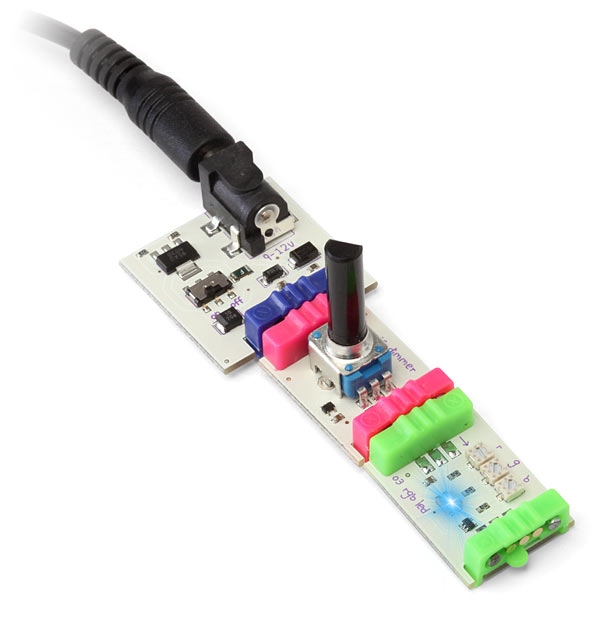
Little Bits of STEM Learning

This might not be eLearning, and I'm not sure if it applies to corporate eLearning, but it is a pretty cool product.  And I know corporate eLearning pros have a little bit, if not a lot, of geekiness inside.

So, if you like to tinker with electronics or want your kids to discover a passion for electronics, then this Little Bits Starter kit might be just the thing for you last minute holiday shoppers.

If you are already a fan of the Arduino then you'll love this for your kids.  It's similar to the Arduino only easier to work with.  The different circuit parts snap together with magnets and everything is color coded making it a great starter kit for kids, or even adults that don't think they have any technical skills but want to play with electronics.

From a learning perspective I do have a concern that since it is SO easy to snap the parts together and make things work I wonder if kids will have the motivation to dig deeper into the understand of WHY it worked.  Just because you can make a light turn on and off with a switch by placing magnets together, doesn't mean you truly understand the completion of a circuit.  I don't want to knock this because I LOVE IT, but I'd like to hear how someone has integrated this into a classroom or other learning setting.


littleBits (re)intro from ayah bdeir on Vimeo.

You can buy the starter kit for $89 at the Little Bits Store.

Tuesday, November 29, 2011

DemoFest Winners Webinar - Nov. 30 10:30am Pacific

demofestIf you missed DevLearn 2011, then you also missed DemoFest and the amazing work of your eLearning colleagues.  The eLearning Guild has taken the projects selected by attendees as outstanding and asked them to participate in a Guild Online Forum. 

This DemoFest Highlights Webinar is scheduled for tomorrow. (Wednesday November 30th - 10:30 to Noon Pacific time)

Be sure to get registered NOW!

http://www.elearningguild.com/devlearn/surveys/index.cfm?sid=182&selection=doc.2128&utm_campaign=dl11demo&utm_medium=banner&utm_source=elg-180l

Friday, September 30, 2011

CONTEXT is KING, but CONTENT is QUEEN. Long Live the Queen!

I've given presentations on this idea as it relates and impacts the future of Learning technologies and solutions that we design/develop/support.  SO, I was VERY excited to see wine geek and entrepreneur Gary Vaynerchuck focusing on CONTEXT today.


CONTEXT is important today because of the proliferation of CONTENT.  In general, I don't think one is more important than the other.  Actually, if you don't have any content you don't worry too much about the context.  But since new technologies have made it so easy to create web media content, there is an over abundance of it.  And so the problem that everyone is concerned with is how do we deal with such an overwhelming amount of information that everyone is participating in creating?  And the answer is in the context.

How we organize, filter and view other people's content is increasingly more important.  This is how we learn about things we didn't know we needed to learn.  It's that serendipitous learning that is going to have a major impact on our industry...in a good way.  The more people discover what they NEED to know, the more likely they are to seek out elearning content to consume and learn more about that topic.  At least that's my theory.

How we decide to share our OWN content is another part of context that we all need to be aware of.  Gary Vaynerchuck is a perfect example of how taking control of your own creation and distribution of media content can make you very successful.  It can also grow your personal brand or your company brand.  Getting your message into a channel that allows readers (learners) to have access to it when they need it, on the device they need it on, is increasingly critical.

Its about People, Content, and Context.  That's really all you need to know about the impact of new media on learning.  You'll notice I did not ad technology as a fourth item.  Why?  Because its not about technology.  Learning has never been about technology.  It's about PEOPLE first and foremost.  Second, its about the CONTENT you create for others to consume in your absence: your writings, your podcasts, your videos, your interactive screencasts, or your full blown learning solution.  And lastly, but getting more play these days is CONTEXT.  Access to content at the right time, in the right place, on the right device is part of it.  But delivery and design is the piece that Facebook is figuring out faster than others.  Visually being aware of the content others are consuming, creating and sharing, in a usable interface is today's winning tech solution.  Apps and new technology solutions that help provide CONTEXT around all of today's content will win the day.

Friday, December 11, 2009

Brain Rules - Getty Images - Vision Trumps all other Senses


In my humble opinion BrainRules should be MANDATORY reading for YOU and all of your eLearning colleagues. When the instructional design of 40 years ago was...well...designed, the only thing we could study was behavior. Today's technology looks inside the brain and tells us what that mass of cells is REALLY up too. If you are in an Instructional Design degree program of any kind and have NOT been exposed to the latest brain research then go get it for yourself...on the Internet. Its all over the place...and in books.

Its these new findings that help us understand why we intuitively know that simulations and virtual, highly visual, spaces are AMAZINGLY powerful learning tools. And it also confirms that creativity is at the heart of truly great instructional design. Words alone simply DO NOT cut it!

Special thanks to @cammybean and @tmiket for tweeting about BrainRules.net and helping to spread the word.

Dr. Medina was SO awesome at DevLearn08, I'm thinking about bringing him back...what do you think?

DevLearn 2010 Conference & Expo - November - San Francisco, CA

Tuesday, June 26, 2007

The Learning Ecosystem - School2-0.org

This just crossed the reader via UTechTips.

You can join the conversation at www.school2-0.org.

Good stuff! It will take some time before the old school guard gets what's going on. But hey, we've all got to start somewhere.

If you are reading this as one of the folks that doesn't think this is a good idea then i would recommend reading Karl Kapps blog of late. In his latest post he references THIS CHART from BusinessWeek. Amazing data that might help you change your mind.

For you business training folks the BusinessWeek chart is data that will support your initiatives supporting the next generation workforce.

And speaking of data...The eLearning Guild 360 Report on Synchronous Learning Systems was released today. A beautiful, comprehensive study well worth a read. SLS will be a huge part of the learning ecosystem and everyone should understand what's working, what's not working, and what's the future going to look like. If you want a little preview then you should attend the webinar as well.

Friday, June 01, 2007

TWiM - Learning to Learn podcast HIGHLY RECOMMENDED


MAJOR UPDATE: Well, being out of the blogosphere for so long confused my brain and I blew it on this one. The post you see below is WRONG! CC Chapman does NOT do TWiM podcast. However, one thing i did get right is that CC is EXTREMELY passionate, and I DO LOVE Managing the Grey (his actual new media podcast) and the CrayonCast. Too many podcasts, so little time :-(
________________________________________

One of my favorite new media gurus is CC Chapman from Crayon. He produces several podcasts but my favorite is This Week in Media.

Sometimes the guys on the show geek out on stuff that don't interest me but I listen anyways because they are passionate about everything. NOTHING beats Passion!!! By far my favorite episode is titled Learning to Learn (episode 53)

Its a great twist on what we are all blogging about because its coming from guys that are NOT jaded with ISD baggage. They are not elearning professionals. These are just passionate, successful guys that learned their craft in a particular way. Its a must listen.

Monday, May 14, 2007

The Encyclopedia of Life - Wiki

The Encyclopedia of Life just crossed my desk and reminds me of how incredibly powerful the web has become as an information resource.

The Press Release page has some great media elements and information on the project.

From the press release:
WASHINGTON (May 9, 2007) – Many of the world’s leading scientific institutions today announced the launch of the Encyclopedia of Life, an unprecedented global effort to document all 1.8 million named species of animals, plants, and other forms of life on Earth. For the first time in the history of the planet, scientists, students, and citizens will have multi-media access to all known living species, even those that have just been discovered.

Over the next 10 years, the Encyclopedia of Life will create Internet pages for all 1.8 million species currently named. It will expedite the classification of the millions of species yet to be discovered and catalogued as well. The pages, housed at http://www.eol.org, will provide written information and, when available, photographs, video, sound, location maps, and other multimedia information on each species. Built on the scientific integrity of thousands of experts around the globe, the Encyclopedia will be a moderated wiki-style environment, freely available to all users everywhere.
So, we start with all of the species of the world and then perhaps we move on to Geology? All I know is that at some point ALL of the possible information required for K-12 will be available via the the net. So...then what? How are the educators of the old-school going to handle that?

This truly makes me wonder if David Williamson Shaffer is right?

Shaffer, D. W. (2004). Pedagogical praxis: The professions as models for post-industrial education. Teachers College Record, 106(7), 1401-1421. http://coweb.wcer.wisc.edu/cv/papers/TCRpedprax.pdf

Or how our children need to learn my "doing" and "becoming" from his book How computer games help children learn.

I'm not sure we can turn the ship that quickly, but from what I've seen parents are taking their kids off the ship. Virtual schools are growing like crazy, and home schooling is not so scary any more. School used to be a resource for learning. But today when your computer provides infinitely more learning possibilities than any brick and mortar can provide it makes me wonder why more aren't jumping off the ship.

Wednesday, May 02, 2007

Tim Wang's eLearning Blog - Great Open Source eLearning Project Links

I exchanged emails with Tim Wang this week. Tim blogs over at Tim Wang's eLearning Blog.

He provided some outstanding open source projects that he contributes too:

Learning Tools: http://www.learningtools.arts.ubc.ca
Pachyderm: http://www.pachyderm.org
Open Croquet: http://www.opencroquet.org
Ancient Spaces: http://ancient.arts.ubc.ca/
Arts Metaverse: http://artsmetaverse.arts.ubc.ca

I LOVE The learning Tools Tim has authored, and links to, in the first link. Great stuff. I haven't used Pachyderm in a while but I remember being very impressed by it. And, of course, I am a huge fan of Open Croquet. I think we are all just waiting for it too mature a little bit more. Ancient Spaces and Arts Metaverse are awesome and I really want to spend more time digging around there.

Tim, thanks for connecting with me! I'm looking forward to hearing from many more of you in the eLearning blogosphere.

SIDE NOTE: I stopped checking my rankings a long time ago...no value for me. Blogging, for me, is about the people and getting emails from others who read and connect too me is just darn cool. I just heard from a cousin (via my blog) I haven't talked too in probably 10+ years. That's darn cool too.

Monday, April 23, 2007

TeacherTube - Tell me why we need to GO to school?

I put out an idea early this month about teachers putting themselves on the open market. The tools I find, the more I see this as our future reality. TeacherTube is great! And since I haven't done my going-into-the-weekend-video post recently (old one here if you need a fix), I'll give it too ya here. This is from TeacherTube to illustrate a point. I'll be there's a hundred ways to take this content and make it "better"...rip, mix, feed. I don't want to take anything away from this teacher because this is how it starts...then someone else adds a little, and then someone else, etc.

The k-8 curriculum seems fairly cut and dry to me. We have teachers all over the world reinventing the wheel over, and over, and over. We currently use the internet to subsidize the learning that is being missed in class for what ever reason. So, when do we begin to realize that the internet can be the primary source, not just something extra? Good/entrepreneurial teachers could quite easily increase their salaries with simple marketing techniques and open source technologies like Google TeacherTube, blogger, pbwiki, and hundreds of others.

Monday, April 09, 2007

Digital Learning Aggregator

Okay, so I borrowed this from Marc Cantor of PeepAgg. He actually calls them Digital Lifestyle Aggregators which works for me too because we are all talking about Life-longer learning as the new cornerstorn by which we do all that we do. So Life, Learning, its all the same to me. If you've stopped learning you've stopped living.
DLAs are definitely the future. At least the concept is right on the money. What tool or how we aggregate our digital life remains to be seen, but its AWESOME to think about it. I've refered to it as the Learning Dashboard in the past. Its the people, stupid! Not the technology. The technology simply connects us with the right people and cultivates the "right" relationships at the right time.
See you all in Boston!

Tuesday, April 03, 2007

NoBS, The end of the MBA

From Seth Godin comes NoBS...the New Order Business School.

Brilliance! I would apply the sentiment to all other forms of formalized academia. The ONLY thing worth attending my graduate program for was the CD-ROM project that connected me with influencial Intel insiders (and a GREAT friend!) Most of the technical learning came from the kids in the lab...the PhD'd instructors didn't have a clue about how the technology worked. Maybe that's changed...I doubt it.

Seth nails it! I was one of those with nothing better to do. No network. No family connections. It was the only road available to me. I kind of feel suckered...a little. Hey, if you want an MBA check THIS site out. Its the PersonalMBA. Can we come up with a PersonalM.Ed?

"Why not get your PhD?" The only reason I can think of is that it looks impressive after my name as the author of a book.

"Why don't you write a book?" Read Stephen Downes fabulous article in the April-May issue of Innovate Online. There is no reason to write books in the age of new media.

I love learning! I LOVE the blogosphere! I've never experienced a better way to learn in my life. If it's not just me, then why don't we teach what it is that we do to TRULY learn?

Thursday, March 15, 2007

Elluminate - FREE Web conferencing

This is AWESOME! Especially for those of us on the outside of corporate funded apps like NetMeeting etc.

While at Intel I became very used to NetMeeting despite its issues. So, I'm very excited to now have my own vRoom that doesn't kill my budget...because its FREE!

I can tell you without hesitation that this is a must have. Go get it! And set up a meeting with me. Seriously, I want to try it out with others...live.

Get your FREE vRoom

(And NO! I don't mind plugging apps on my blog. Especially when its a free app that has value.)

Friday, March 09, 2007

gLMS - Could it be coming...

With LMS2007 coming up in April, I'm reminded of some of the discussions in the blogosphere.
LMS, we hardly knew ye is classic Jay Cross. I love it. Or this from EducauseCONNECT End of LMS? Of course the only 2 comments reference Legal and privacy issues regarding open alternatives. Which are only relevant if you are an institution fearing legal recourse. When we eliminate the moneymaking institution we eliminate the target of legal action. So for the sake of conversation lets just not talk about Legal and privacy issues.

Disclaimer: I've used them, I've participated in needs analysis for purchasing an LMS, but other than that most of my career has been focused on Learning, technology, and Content development...until now.


Has everyone seen or read about Google Apps for Education?
"Imagine how valuable it would be if your entire campus community -- students, faculty, and staff -- could share information and ideas more easily. With Google Apps Education Edition’s free communication, collaboration and publishing tools, including email accounts on your school’s domain (like student@your-school.edu), you can start bringing that vision to life.

You can select any combination of our available tools and services and customize them with your school's logo, color scheme and content. Manage your users through a web-based control panel, or use the APIs to integrate Google Apps into your existing systems.

Best of all, it's all hosted by Google, so there's no hardware or software to download, install or maintain. You can get up and running quickly with minimal support from your IT staff."
Check it out right NOW!

hmmm....

thinking...hmmm..

hmmmmhhhhmmmmm...


okay, you back with me?


Did you notice the 6 apps that are included? There is the obvious gMAIL, docs, spreadsheet, calendar, talk, etc. HOWEVER...did you see Extensibility APIs. Yea! I know!
WOW! Wait...you still don't see it? Look again! No...read BETWEEN the lines...

Did you see gLMS...Google Learning Management System? I didn't either, at first, until I started thinking about it as a techno-geek instead of a learning-nerd. Its nothin' but a tiny chunk of work from your friendly neighborhood coding ninja and you end up with everything you need to completely manage your "school". I put school in parenthesis because web2.0 will completely change the image of what that word actually means. The gLMS supports the Learning Ecosystems of the future not the bricks and mortar environments of the past.

But you say..."Brent, there's no database! It can't be an LMS without a database!"

I say...hmmmm...what if we used spreadsheets? Besides isn't that what we used before the databases? Databases are columns and rows...spreadsheets are columns and rows.

I'll be interested to hear from those techno-geekier than me can help me understand if this is possible. And I'd love to hear from those that are learning-nerdier than me to understand...well...not sure what I want to understand there when it comes to an LMS.

A quick look at the LMS2007 Sponsors does not show the presence of Google, however I'm certain there must be someone there just chomping at the bit to make this happen. If not Google...then anyone interested in starting a little project with me? ;-)

I'm not able to attend the LMS2007 conference this year, but I'm hoping someone will be live blogging it. I'm VERY curious. It should be a great show because its definitely relevant and contextual in these web2.0 shifting times.


Monday, February 26, 2007

DIY not ISD

I've been beating this drum for many months now. DIY is killing ISD. Conversations around the irrellevance of ISD with Karl Kapp basically bring us full circle to this post by Harold Jarche. Thanks Harold! Its a realization that many are unwilling to accept.
"If you’re in the learning business, don’t try to build another LMS or portal. Instead, figure out ways that enable DIY. Believe it or not, learners can, and will, do the rest. They already are."

Thanks Tony for linking up to it.

Harold's post points to Donald Clark kicking off this conversation. A comment on this wonderful topic had this to say in response to Donald "not getting Starbucks"...
"Starbucks - the classroom of elearning 2.0?"
Well said Dan.

A quick search of my blog finds the following posts:

DIY eLearning Video
DIY inhouse Photo Studio
DIY Visual Thinking School
Kids' Informal Learning with Digital Media
MAKE Instructable eLearning

And there's more, but you get the idea...

I can over-simplify the issue significantly and state the following: ISD is only necessary when you are mandating learning to unwilling participants...for everthing else we do indeed learn it ourselves.

Saturday, February 17, 2007

Learning and SUCCESS - Made to Stick


While the workweek is for surfing the Learning feeds, I enjoy catching up on my DESIGN and MARKETING folders on the weekends. This is sad because MOST of what I do IS design and marketing. (Remember, much of marketing is getting people to "know" about a product and service...i.e. Learning) I think its mostly because I just can't handle another 100 feeds during the weekdays.

From LOGIC+EMOTION comes this quick post about a book signing with the authors of the book Made to Stick.

The key traits of sticky ideas are listed like this:

Simple
Unexpected
Concrete
Credible
Emotional
Stories

Wow! Sounds a lot like the ingredients for effect transfer of knowledge to me.

On a different topic...yet related. I've recieved a lot of feedback possitive and negative regarding my response to the February BIG QUESTION. BTW - I love the feedback...good and bad...it helps me clarify my thinking. But to my point...I think Marketing suffers from the same problem as Instructional Design. Marketing combines many of the different -ologies for their work as well: anthropology, psychology, technology, etc.

What can we learn from the field of Marketing might make for a great next BIG QUESTION.

Monday, February 12, 2007

The February BIG QUESTION!

What Questions Should We Be Asking?

Well...here we go again! Everybody says all of the really great things before I get a chance to, so all I'm left with is "yeah, go look at what these cool people said".

Check out Mr. Oehlert's unique perspective and you'll also get links to the other smart people.

Me? Well, I think the biggest question is STILL, "Why US?". Why do we ("learning professionals") continue to think we have the answers that are special to learning...how it should be done...who should create it...and how should others consume it? Maybe the question is "Do we still add value to the new learning equation?"

Technology IS driving the changes in learning these days: Search (rip), create (mix), connect (feed). These tiny little words RULE the new world. Here it is put another way..."Do people really need us (ISDers) any more?" Or, "Does your company really need you (me, us) any more?"

This main theme continues to smack me in the head over and over and over again...ouch! Stop that! EVERYTHING we need...let me say that again...E-V-E-R-Y-T-H-I-N-G, we need to know about creating effective media for learning is being done by OTHER professions. That's what keeps hitting me in the head...where's the added value from ISD?

Here's what specifically smacked me in the head over the weekend:
It comes from comic books and the contiguity principle.
First, the contiguity principle: placing text near graphics improves learning. Holy crap! Is THAT the best we can do? There isn't a bigger NO DUH that I can possibly think of.
If you want to understand how graphics and words relate and how to best apply them in your elearning...look no further than Understanding Comics. Scott McCloud has it nailed. Oh, and by the way he nails Storytelling as well which is, by far, the most time tested form of knowledge transfer known to man. Do we EVER talk about storytelling in ISD? No. Why? Because its about them and it's not about us. People tell stories intuitively with each other...without the meddling of an ISDer. People learn just find without us. And not only that, the web is making it possible for people to...GASP...learn from each other...WITHOUT us! Holy career crashers, Batman!

What is it that we actually bring to the party? That's the question I want answers too.

(My apologies to Ruth Clark for this. I am a big fan and highly respect her work. Its obvious that this principle had to be defined because so many people just didn't get it and needed to "see the research".)

Also, see the technical writers community for learning how to write...and see your local programmers community for how to program in your app of choice...and see the neuroscientists for brain-based learning...and the anthropologists for social behavior...and see your local high schooler for text messaging tips...and see professional photographers to understand pictures...and see your local graphics designer to understand colors impact on viewers...and see game developers to understand simulation...and on...and on...and on.